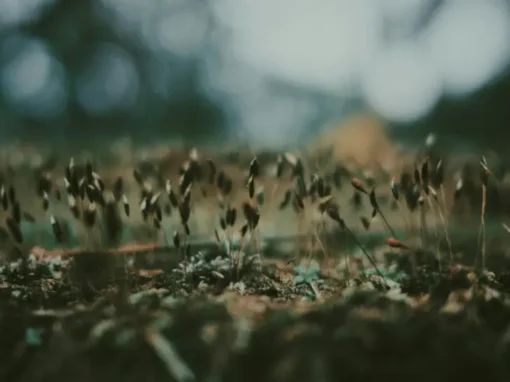
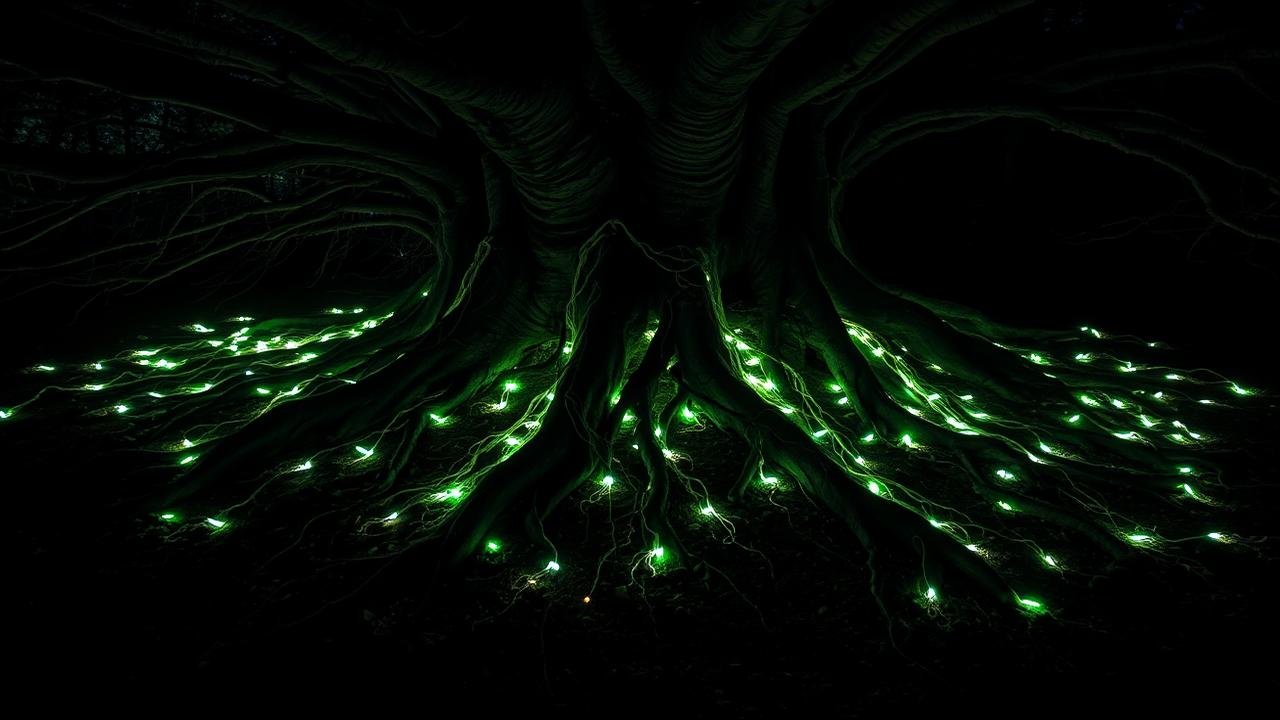
Long before fiber optic cables circled the globe and satellites beamed data across continents, there was another network — one that connected millions of organisms across vast distances, enabling them to share resources, send warnings, and coordinate responses. This network operates beneath the forest floor, and it has been running, uninterrupted, for at least 450 million years.
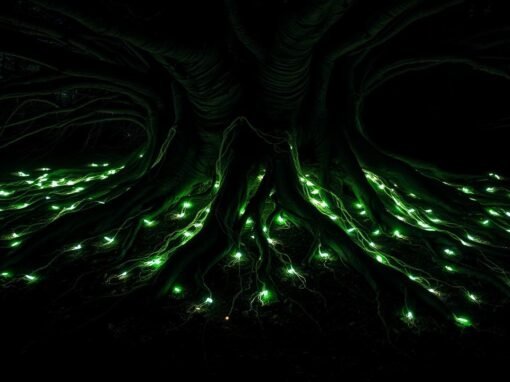
Scientists call it the mycorrhizal network. Journalist Suzanne Simard, whose groundbreaking research brought it to public attention, calls it the Wood Wide Web. It consists of gossamer-thin fungal threads called hyphae that connect the roots of trees and plants in an underground mesh of staggering complexity. A single teaspoon of forest soil can contain miles of these threads.
The relationship between fungi and plants is one of the oldest and most successful partnerships in the history of life on Earth. The fungi colonize the roots of plants, extending the root system's effective reach by orders of magnitude. In exchange for sugars produced by the plant through photosynthesis, the fungi deliver water and essential minerals — particularly phosphorus and nitrogen — that the plant could not access on its own.
But the network does far more than facilitate nutrient exchange. Research has shown that trees use mycorrhizal connections to share resources with one another. A large, established tree — what Simard calls a 'mother tree' — can channel sugars and nutrients to younger seedlings growing in the understory, giving them a better chance of survival. This is not random leakage. It is targeted support, often directed preferentially toward the mother tree's own offspring.
Even more remarkably, trees use the network to communicate. When a tree is attacked by insects, it can send chemical signals through the mycorrhizal network to neighboring trees, warning them of the threat. The neighboring trees then ramp up their own chemical defenses before the insects even arrive. This is not metaphorical communication. It is genuine information transfer, mediated by biochemical signals traveling through fungal threads.
The implications of this research are profound. For decades, the dominant model of forest ecology was competitive — trees competing with one another for light, water, and nutrients in a Darwinian struggle for survival. The mycorrhizal network reveals a very different picture: one of cooperation, mutual aid, and community. Trees, it turns out, are not isolated individuals. They are nodes in a network, participants in a community that functions, in many ways, as a single superorganism.
This challenges some of our deepest assumptions about nature — and about ourselves. We tend to project our own cultural values onto the natural world, seeing competition where there is cooperation, isolation where there is connection. The Wood Wide Web invites us to reconsider these projections. What if the fundamental organizing principle of life is not competition, but relationship?
There are practical implications as well. Industrial forestry, which treats trees as isolated units to be harvested and replaced, disrupts mycorrhizal networks in ways that may take decades to recover. Clear-cutting a forest does not just remove trees — it destroys the communication infrastructure that sustains the entire ecosystem. Understanding this has led to new approaches to forest management that prioritize network integrity.
The next time you walk through a forest, look down. Beneath your feet, invisible and silent, a vast intelligence is at work — sharing, communicating, cooperating. It has been doing so since long before humans existed, and if we are wise enough to protect it, it will continue long after we are gone. The original internet is not made of silicon and copper. It is made of life.